
Summit County Court Records After Arrest
A jail arrest and a court case are linked, but they are not the same record. A person may be arrested by the Summit County Sheriff's Office or a local police agency, booked at the Summit County Detention Facility, and then brought into the court path. Once the prosecutor reviews reports and evidence, the filed charges become part of the court record. That court record may differ from the booking charge used at intake.
Summit County is in Colorado's 5th Judicial District. The 5th Judicial District Attorney prosecutes criminal cases in Eagle, Summit, Lake, and Clear Creek counties. The current DA identified in the research is Heidi McCollum. Formal case records are handled through Summit Combined Courts and Colorado Judicial Branch channels, not through the jail roster or booking-photo process.
For custody and booking detail, use Summit County jail inmate records. For booking photos, use the Summit County jail mugshots route. Court records after a jail arrest focus on filed charges, hearings, orders, bond settings, warrants, dispositions, and official copies of case documents.
Search Summit County Court Records
The Colorado Judicial Branch docket search is the public starting point for many hearing and docket questions. It is useful for upcoming events and case navigation, but public online data is not the official court record. For official documents, registers of action, certified copies, or older and restricted files, use the Summit County court record request process.
- Use the Colorado Judicial Branch docket search and select Summit County where the form requires county or court selection.
- Search by date, case number, division, or defendant information when the portal allows it.
- Compare the docket entry with jail or bond information, because a jail booking charge can change after prosecutor review.
- Request official case documents from Summit Combined Courts when the docket does not answer the question.
| Field Label | Type | Use |
|---|---|---|
| County | Dropdown | Select Summit for Summit County matters. |
| Court | Dropdown | County or district court options depend on county and case type. |
| Date or date range | Date | Docket search is often date-oriented for hearings. |
| Case number | Text | Best exact path when known. |
| Division | Dropdown or text | Needed for some docket searches. |
The Colorado docket-search screenshot in the manifest shows the state docket portal used for hearing and court-event lookup.
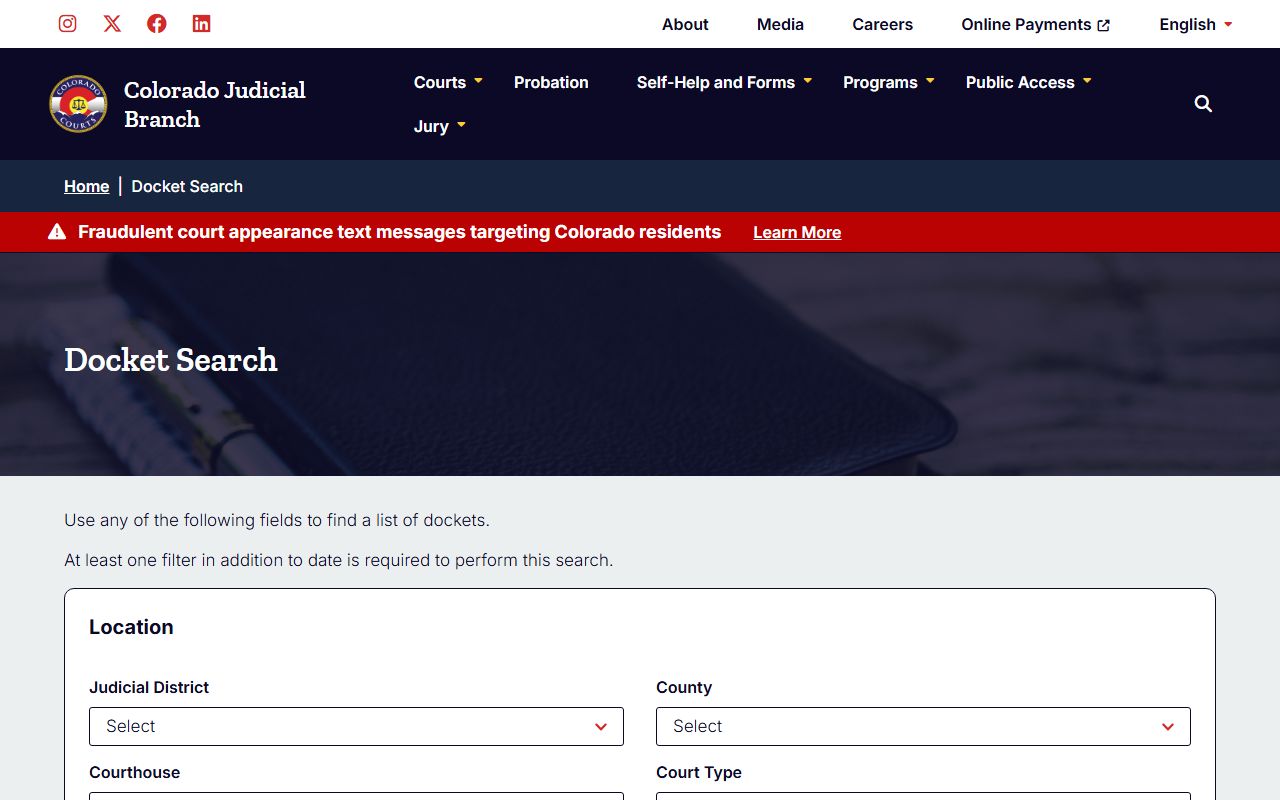
Use the docket as a navigation tool, then request the court file when an official record is needed.
Request Summit County Court Documents
The official Summit County court page links to a Record/Document Request Form. The Judicial Branch page identifies SummitRecordsRequest@judicial.state.co.us. The form is for Summit County Combined Courts and includes requests for a Register of Action, case documents, certifications, exemplifications, and court record research.
A Register of Action is a court summary that can include charges, sentences, and minute orders. It is often a better document than a jail note when the question is what the prosecutor filed or how the charge ended. The clerk may restrict access to court files or portions of files under Colorado statutes, rules, Chief Justice Directives, local administrative orders, or other legal authority.
| Record Need | Best Summit County Route | What to Have Ready |
|---|---|---|
| Upcoming hearing | Docket search or Summit County Courts | Name, case number, or hearing date. |
| Filed charges | Register of Action or case document request | Case number, defendant name, approximate filing date. |
| Certified copy | Court record request form | Case number and requested document title. |
| Booking report | Sheriff records, not court clerk | Arrest date, agency, incident number if known. |
Charging Records After Arrest
The prosecutor's filing decision is the key step that turns an arrest into a court case. The jail may list an arrest basis, warrant basis, or initial booking charge, while the court case reflects the complaint, information, indictment, or amended filing used by the District Attorney. This is why a person may be booked on one wording and later see a different charge title or count in court records.
| Document | Plain Meaning | Summit County Use |
|---|---|---|
| Complaint | Initial charging document that opens many criminal cases. | Common early court filing after arrest review. |
| Information | Prosecutor-filed charging document after evidence review. | Common in felony prosecutions. |
| Indictment | Grand-jury charging document. | Less common for ordinary local jail arrests. |
| Citation or summons | Case start without continued jail custody in some lower-level matters. | May appear where arrest and detention are not the path. |
Summit County Charge Status
Charge status can change quickly after a jail arrest. A filed charge can be pending, amended, reduced, dismissed, deferred, adjudicated, or disposed. A dismissed charge is not a conviction. A conviction is a court outcome after a plea, verdict, or other adjudication. Court records after a jail arrest are the better source for this status than a jail intake note.
| Status | Meaning |
|---|---|
| Pending | The case or charge has not reached final disposition. |
| Amended | The prosecutor changed the filed charge or count. |
| Reduced | The charge level or charge type was lowered through court action or agreement. |
| Dismissed | The charge was dropped or ended without conviction on that charge. |
| Deferred | The case may be held under court-set conditions before final outcome. |
| Convicted | A conviction followed a plea, verdict, or other adjudication. |
Bond After Summit County Arrest
Bond appears in both jail and court conversations. The sheriff's court-date page routes housed-inmate court date questions to Summit County Courts or Detention Facility extension 1. The bonding page says bond can be posted by cash, credit card, or bonding agent, and bonding agents may contact the facility for remote bonding support.
Colorado's C.R.S. 16-4-102 notice on the Summit page says the payor only needs to pay the bond amount to secure release. Bond fees, booking fees, and other debts do not need to be paid first. A $10 bond fee and a maximum 3.5% credit-card payment fee may be charged as debt if not paid at bonding. The release timing clock depends on the statutory conditions being met, and holds can still block release.
| Bond Term | Meaning |
|---|---|
| Cash bond | Money paid to secure release and court appearance. |
| Surety bond | Bond posted through a licensed bonding agent. |
| PR bond | Release on promise to appear without paying the full money bond. |
| No-bond hold | Custody status that prevents ordinary release until a court or hold issue changes. |
Warrants After Summit County Arrest
No official Summit County Sheriff's active warrant search or public warrant list was located on the sheriff website during research. A warrant arrest can still lead to booking at the Summit County Detention Facility, and court records may show failure-to-appear events, bench warrants, or warrant returns. Call the Detention Facility or Summit County Courts for official routing where a warrant may have led to custody.
Possible warrant record fields include defendant name, case number, issuing court, warrant type, case basis, date issued, bond amount or no-bond status, and return or service status. Those are general court or law-enforcement fields. They should not be described as fields from a Summit County online warrant search because no such official public search interface was found.
Charge Versus Conviction
A charge is an allegation filed in court. A conviction is a result after a plea, verdict, or other adjudication. Court records after a jail arrest should be read with that difference in mind, especially when the jail booking wording differs from the court filing or when charges were later amended or dismissed.
| Question | Charge | Conviction |
|---|---|---|
| What it means | Allegation or filed count. | Court outcome after adjudication. |
| Where it appears | Complaint, information, docket, register of action. | Disposition, judgment, sentence, or register of action. |
| Can it change? | Yes, charges can be amended, reduced, or dismissed. | Changes only through later court action, appeal, sealing, or related relief. |
Sealed Court Records After Arrest
Colorado public access changes when a case is sealed or restricted. Juvenile matters, sealed arrests, protected victim or witness material, and other restricted records may not appear through ordinary public tools. The Colorado Judicial Branch public records access guide explains that online data is not the official court record and that different rules control access depending on record type.
| Concept | Sealed | Expunged |
|---|---|---|
| Public access | Access is restricted from ordinary public view. | Access is removed or treated under a separate statutory process where available. |
| Common Colorado route | Colorado Judicial Branch sealing self-help. | Depends on the record type and law; not every adult record has the same path. |
| Effect on lookup | Public docket or record tools may not show the case. | Public records may be unavailable or limited by order. |
Colorado Criminal History Search
The Colorado Bureau of Investigation ICHC is a statewide Colorado-only criminal history search. It is not a Summit County court docket, jail roster, or warrant search. CBI notes that juvenile arrests, sealed arrests, and traffic arrests under age 16 are exceptions, and that each downloaded search result can carry a separate fee.
Important: Do not use informal inmate or court lookups for employment, tenant screening, credit, insurance, or any FCRA-covered decision.